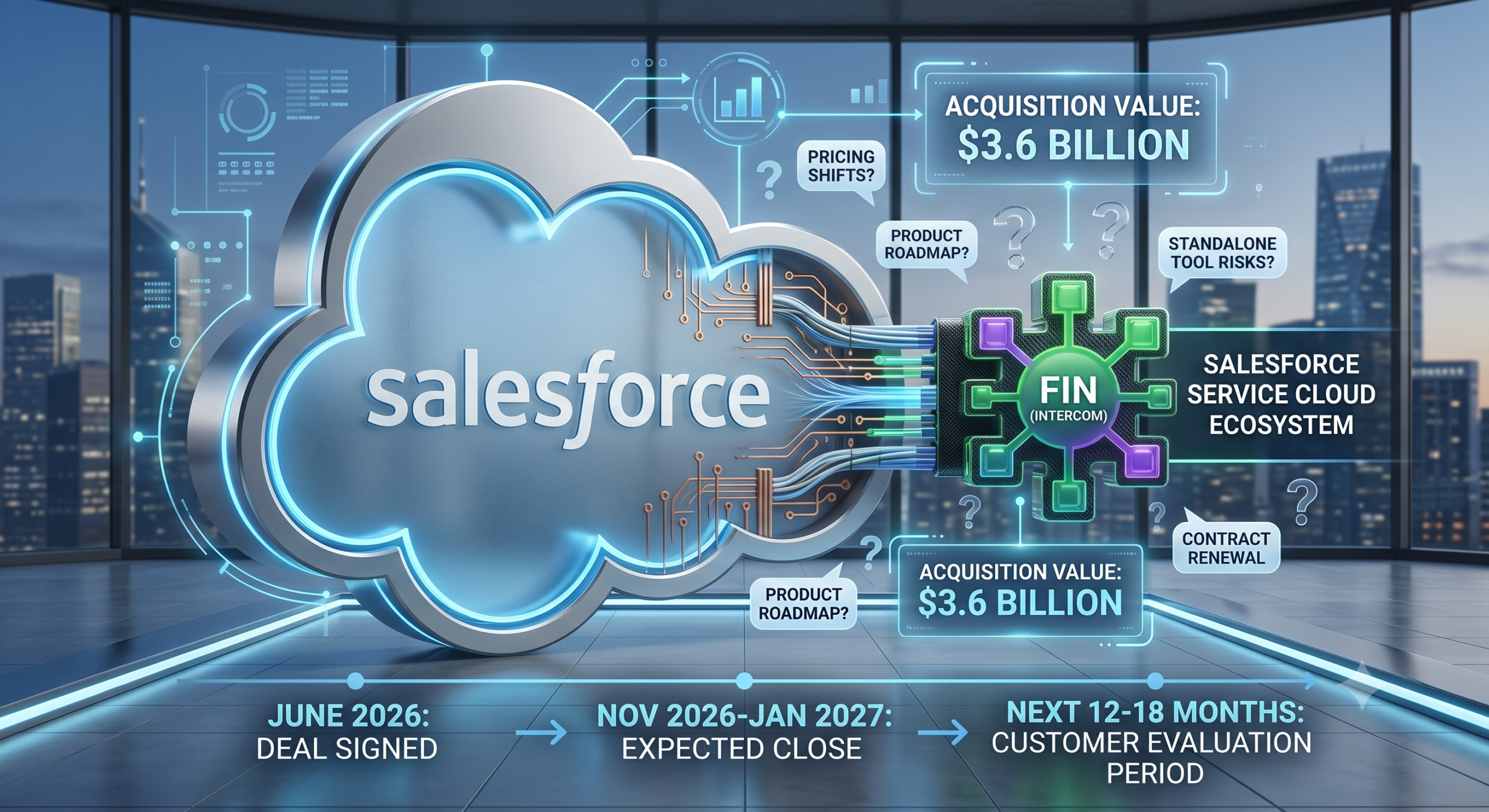
Salesforce Is Acquiring Fin (Intercom) — What Happens to Existing Customers?
On June 15, 2026, Salesforce signed a definitive agreement to acquire Fin, the AI customer service platform formerly known as Intercom, in a deal worth $3.6 billion. The deal is expected to close between November 2026 and January 2027. For the roughly 30,000 customer service teams currently running on Fin, this isn’t just a headline — it’s the start of a planning conversation that usually gets delayed until it’s urgent.
Why Acquisitions Like This Trigger a Re-Evaluation
Whenever a platform gets folded into a larger ecosystem, a few things tend to happen — not immediately, but within the first 12-18 months: pricing structures shift toward the parent company’s model, product roadmaps get reprioritized around the acquirer’s strategy, and standalone tools risk losing the focus they had as an independent product. None of this means Fin is going away tomorrow. It does mean the terms most customers signed up for were written for a different company than the one that will eventually own the platform.
$3.6B — Acquisition value
~30,000 — Customer service teams currently on Fin
6-18 months — Typical enterprise re-evaluation window after a major acquisition
What Fin Customers Should Be Watching For
Integration timeline into Salesforce’s existing Service Cloud stack
Pricing changes once the deal closes (expected Nov 2026-Jan 2027)
Whether Fin remains a standalone product or gets absorbed into a broader Salesforce bundle
Contract renewal terms coming up during or after the transition window
This pattern isn’t new. Similar acquisitions in the CX and CRM space have historically led to bundled pricing, forced migrations, or feature deprioritization for the acquired product within a year or two of closing. Teams that start evaluating alternatives early — before a forced renewal deadline tend to have more leverage than those who wait.
Major vendor consolidation rarely changes anything on day one. It’s the 12-18 months after close where customers actually feel the shift.
How Revnity Marketing Can Help
We track verified install-base data for CX and customer service platforms, including companies currently running Fin/Intercom. If you’re evaluating alternatives — or building a GTM motion targeting this displacement window — we can provide a verified list of companies still on the platform, not a modeled guess. See our TECHNOGRAPHIC INTELLIGENCE page for coverage details.
Building outreach around this acquisition?
Request a sample file of verified Fin/Intercom install-base data
Why Your Competitors’ Customers Are Your Warmest Leads
Here’s a counterintuitive truth most B2B marketers miss: the companies using your competitor’s product are not your enemies’ territory — they’re your highest-probability pipeline. They’ve already validated the problem space. They have a budget. They understand the category. The only question is whether they’re happy with what they’ve got.
And in most categories, a significant portion of them are not.
68%
of B2B buyers actively evaluate alternatives at least once per year
3.2x
higher conversion rate when outreach is informed by technographic context
$0
additional education cost — competitor customers already know the category
The challenge isn’t finding these companies — it’s knowing which ones to target, when to reach out, and what to say. That’s exactly what technographic intelligence solves.
Companies already using a competing solution are pre-educated, budget-confirmed, and problem-aware. They are the most efficient lead you can acquire — if you know how to reach them.
How to Identify Who Uses Your Competitors
Technographic data maps which companies are using which software, cloud platforms, hardware, and tools — in real time, at scale. At Revnity, we track 45,000+ technology products across 200M+ user records globally. This means you can pull a list of companies currently running any competitor’s solution — filtered by geography, company size, industry vertical, and more.
What “competitor technographic data” actually includes
A technographic record for a competitor customer typically includes: the company name, domain, industry, size, location, technology product being used (your competitor), their broader tech stack, key decision-maker contacts, and estimated contract age — all signals you can use to qualify and prioritize outreach.
The three tiers of competitor accounts
Not all competitor customers are equal. A useful way to segment them is by propensity to switch:
Growing company, outgrowing current solution, tech stack expanding
Medium
Nurture + trigger-based
🌱 Low Propensity
Recently onboarded, happy user signals, small team
Lower
Long-game nurture only
Reading Switching Signals in Technographic Data
The power of technographics isn’t just who uses a competitor — it’s reading the signals around that usage to understand when they might be open to a conversation. These signals are embedded in the data layer.
Signal 1: Tech stack expansion without depth
When a company starts adding multiple point solutions around a core tool — patching gaps with workarounds — it’s often a sign they’ve hit the ceiling of their current vendor. If you see a company using Competitor X plus 3–4 separate tools that your platform replaces natively, that’s a displacement opportunity.
Signal 2: Company growth milestones
Funding rounds, headcount growth, and new office openings are inflection points where companies re-evaluate their entire stack. A Series B company that raised 18 months ago is now at the point where their scrappy early tools need upgrading. Technographic + firmographic data combined surfaces this perfectly.
Signal 3: Competitor product gaps becoming public
When your competitor releases a controversial update, faces a public incident, or a review wave hits — a spike in sentiment data aligned to technographic user lists gives you a precise window to engage their frustrated customer base.
Want to see who’s using your competitors?
Get a free sample of competitor technographic data — filtered to your target market.
A competitor displacement campaign is different from a standard demand gen campaign. It requires sharper segmentation, more specific messaging, and a longer runway. Here’s how to structure it:
1
Define your displacement target list
Pull the technographic user list for each competitor you’re targeting. Apply firmographic filters — company size, geography, industry — to match your ICP. The output is your Priority Displacement Account (PDA) list, delivered with accuracy-verified contact data included.
2
Score accounts by switching propensity
Overlay the signals above — stack complexity, company growth stage, contract age estimate — to assign a propensity score. Focus your SDR bandwidth on the top 20% first. This alone dramatically improves outreach efficiency.
3
Build competitor-specific landing pages and content
Create dedicated comparison pages, migration guides, and ROI calculators tailored to users of each specific tool. When a prospect searches alternatives after hitting a pain point, you want to be right there — with proof, not platitudes.
4
Run a parallel paid + direct outreach motion
Layer LinkedIn ads targeting your PDA list (using matched audiences) with a direct email sequence from your SDR team. The dual-channel approach creates recognition before the cold email lands — dramatically increasing reply rates.
5
Offer a migration incentive
The #1 barrier to switching isn’t price or features — it’s friction. Offer a free migration audit, a dedicated onboarding engineer, or a risk-free trial period. Remove the activation energy and switching becomes much more likely.
Messaging That Actually Converts Competitor Customers
Most “we’re better than X” messaging fails because it’s generic. Effective displacement messaging is hyper-specific about what they’re experiencing right now. Here’s the framework:
The 3-line displacement email formula
Line 1 — Empathy: Name the specific pain they’re likely feeling with Competitor X.
Line 2 — Proof: Share a one-sentence result from a company that made the same switch.
Line 3 — Low-friction ask: Ask for a 15-minute call to share how one other company in their industry handled the transition — not to pitch.
The key is that none of this feels generic. It references their actual vendor, speaks to pains that vendor specifically creates, and reduces the perceived risk of the next step.
Messaging do’s and don’ts
Do reference the specific product they use by name — it signals you’ve done your homework
Do speak to migration ease upfront — it removes the biggest objection before it’s raised
Do use peer proof — “a company like yours switched and saw X” beats any feature list
Don’t trash the competitor — it comes across as insecure and damages trust
Don’t lead with a demo ask — it’s too high-commitment for a cold contact
Don’t send one email and give up — displacement needs 6–9 touchpoints over 6–8 weeks
The Revnity Playbook: Step-by-Step
Here’s exactly how Revnity clients execute competitor displacement campaigns with our data:
Request your competitor’s user list — tell us which technology products to pull and your ICP filters, and we deliver a verified, CRM-ready contact database within 3–5 business days.
Append full tech stack context — via Stack Data Append, we add the full technology environment of each account so you can tailor positioning.
Identify your champion contacts — using Title-Based Database filters, pinpoint the economic buyer, champion, and technical evaluator at each account.
Load into your CRM and sequences — all data is delivered CRM-ready (Salesforce, HubSpot, etc.) with enriched fields so outreach can start immediately.
Run a 90-day campaign — measure pipeline created from displacement accounts vs. standard cold outreach, and iterate on messaging based on reply signals.
Competitor Displacement vs. Standard Cold Outreach
2%
7%
Reply Rate
1.5%
5%
Meeting Rate
12%
38%
Close Rate
Standard cold outreach
Technographic displacement
Ready to start winning competitor accounts?
Get a free sample of technographic data for your top competitor — filtered to your exact ICP, delivered in 72 hours.